
Legal Compliance for Expatriate Workforce in Foreign Direct Investment
Sep 9, 2025
In a high-profile raid on September 4, 2025, involving the combined forces of multiple U.S. federal and local law enforcement agencies, the Foreign Direct Investment (“FDI”) joint venture project between Hyundai and LG Energy Solution in Georgia captured global headlines. It was reported that the project site engaged in unfair employment practices, including the illegal employment of foreign nationals and the exploitation of the U.S. workforce. This incident follows a familiar pattern seen in recent years, such as CITIC Dicastal’s raid in 2022 during the previous administration, Fuyao’s raid last in between the two administrations, and more recently a raid on Georgia flooring manufacturer in March. Especially in light of President Trump’s use of tariff to incentivize the restoration of manufacturing jobs in the U.S., it is increasingly critical for manufacturers, both current and prospective FDI, to ensure rigorous compliance with U.S. labor and immigration laws, especially regarding expatriate workforces who are either employed by the controlling foreign entity directly or its network of contractors (“Expat”). Expat is usually consisted of managers and professionals who are well versed with the FDI’s core technologies and processes to be imported to the U.S., making them essential for the success of any FDI projects, especially those which involve a highly specialized field. In another words, ensuring Expat’s presences and activities are legal in the U.S. is necessary for fulfillment of the local workforce training and expected jobs creation.
FDI projects have several potential pathways for bringing Expat into the United States. This article does not focus on the H-1B specialty occupation or H-2B temporary non-agricultural worker programs, as both are constrained by strict annual quotas, making them too unpredictable to serve as reliable options. Similarly, while the L-1B specialized knowledge and E-2 essential employee categories may be available in limited circumstances, their highly selective nature renders them impractical for deployment at scale. This article examines the feasibility of B-1 Commercial/Industrial Workers and H-3 Trainees program in FDI projects.
B-1 Commercial/Industrial Workers
First of all, it is perfectly legal for B-1 business visitors to come to the U.S. to install, service, or repair equipment/machinery purchased from a foreign company or to train U.S. workers to perform such services[1], provided that the contract of sale must specifically require the seller to provide such services or training and B-1 workers must possess unique knowledge that is essential to the seller’s contractual obligation to perform the services or training and must receive no remuneration from a U.S. source[2]. Nevertheless, it is important to note that it is illegal for B-1 workers to perform building or construction work, whether on-site or in-plant. The only exception is that they can supervise or train other workers engaged in building or construction work [3]. This is a purposeful move on part of Immigration Naturalization Service in 1985[4], which is the predecessor of the U.S. Department of Homeland Security.
H-3 Trainees
In addition, H-3 trainees including B-1 in lieu of H-3, are also widely utilized for Expat. In order to sponsor H-3 trainees, there must be a training program that meet the following condition as set forth in 8 CFR 214.2(h)(7)(ii)(A): (1) The proposed training is not available in the foreign national’s own country; (2) The foreign national will not be placed in a position which is in the normal operation of the business and in which citizens and resident workers are regularly employed; (3) The foreign national will not engage in productive employment unless such employment is incidental and necessary to the training; and (4) The training will benefit the foreign national in pursuing a career outside the United States. United States Immigration and Citizenship Services further outlawed training programs, amongst other conditions, that is on behalf of a trainee who already possesses substantial training and expertise in the proposed field of training; will result in productive employment beyond that which is incidental and necessary to the training; is designed to recruit and train nonimmigrants for the ultimate staffing of domestic operations in the United States; or does not establish that the U.S. business has the physical plant and sufficiently trained workforce to provide the training specified[5].
FDI Stages and Compliance
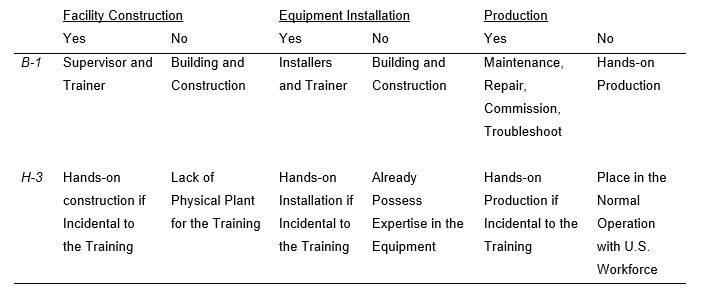
FDI manufacturing projects, just like any manufacturing projects, usually evolve through three major stages: facility construction, equipment installation, and production. The following is a chart listing the allowable activities and restrictions of each abovementioned compliance solution.
Other Considerations and Conclusion
The criminal dimension highlighted by these raids in recent years also underscores allegations of human rights violations within some of these FDI projects. Their arrangements can appear as though they are working for little or no pay, with compensation covering only basic necessities. Exacerbating this perception are language barriers and the paternalistic management styles commonly associated with some Eastern cultures, which frequently lead to centrally managed lodging and transportation, raising concerns about restrictions on personal freedom. Cultural and habitual differences further complicate the situation. Many Expats prefer to stay in group in an apartment or single-family home, so they can prepare their own meals rather than relying on hotels, but with demanding project milestones, such arrangements can result in substandard living conditions, particularly with respect to hygiene. Taken together, these circumstances may serve as grounds for the well-hearted but unfortunate criminal prosecution of FDI project management under the laws.
In conclusion, while the legal framework underlying these enforcement actions has existed for decades, it has not historically been applied with the same rigor as in recent years. Foreign companies should not view stricter enforcement as a deterrent to U.S. investment. On the contrary, consistent application of the law ultimately enhances certainty and reliability, which benefits both domestic and foreign businesses in the long run. In the meantime, FDI projects should take proactive steps to ensure Expat are in full compliance with U.S. regulations and, where necessary, cooperate with law enforcement to develop corrective measures—provided such cooperation is safe and permissible, especially taking their job creations and local workforce training aspect into consideration. This article has intentionally avoided dense legal jargon to remain accessible to a broad audience. In reality, this area of law is considerably more complex than outlined here. Current clients and other interested parties are strongly encouraged to consult experienced legal counsel before taking any action or formulating compliance strategies.
For additional information, please contact any of the following:
He Xian, PhD. at [email protected], with any questions or more specific situations.
[1] See https://www.cbp.gov/document/faqs/b1-permissible-activity-frequently-asked-questions
[2] See 9 FAM 402.2-5(E)(1)(a)
[3] See 9 FAM 402.2-5(E)(1)(b)
[4] See also INTERN. UNION OF BRICKLAYERS v. Meese, 616 F. Supp. 1387 (N.D. Cal. 1985)
[5] See USCIS Policy Manual Vol 2, Part J, Chapter 3.
About FisherBroyles, LLP
Founded in 2002, FisherBroyles, LLP is the first and one of the world’s largest distributed law firm partnerships. The Next Generation Law Firm® has grown to hundreds of partners practicing in 32 markets globally. The FisherBroyles’ efficient and cost-effective Law Firm 2.0® model leverages talent and technology instead of unnecessary overhead that does not add value to our clients, all without sacrificing BigLaw quality. Visit our website at www.fisherbroyles.com to learn more about our firm’s unique approach and how we can best meet your legal needs.
These materials have been prepared for informational purposes only, do not constitute legal advice, and under applicable rules of professional conduct governing attorneys in various jurisdictions, may be considered advertising materials. This information is not intended to and does not create an attorney-client or similar relationship. Whether you need legal services and which lawyer you select are important decisions that should not be based on these materials and information alone.
© 2026 FisherBroyles, LLP